
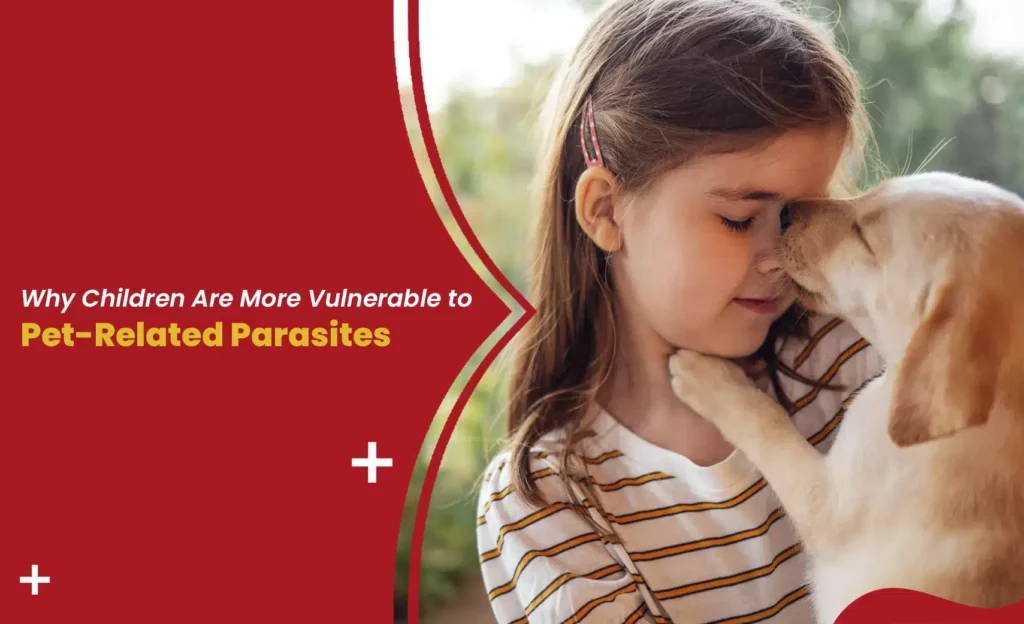
Pet related Parasites in Children are a growing concern for parents, especially in homes where kids and pets share close daily contact.
There’s a particular kind of love between children and pets.
It’s messy. Loud. Unfiltered. A toddler hugging a Labrador with sticky hands. A five-year-old whispering secrets into a cat’s fur. A child lying on the floor, nose-to-nose with a golden retriever who probably just licked its paws.
It’s beautiful.
It’s also… biologically complicated.
Because while pets bring emotional comfort, routine, and joy into a household, they can also carry microscopic passengers. Most of the time, those passengers cause no trouble. But when they do, children are often the first to feel it.
And there are reasons for that – real, physiological, developmental reasons – not just “kids are messy” clichés.
The Biology Behind Pet Related Parasites in Children
Children’s immune systems are still learning.
That’s not a flaw. It’s a process. Every cold, every scraped knee, every mild infection is part of a kind of ongoing training program. But that training phase means they’re sometimes more susceptible to organisms that adults might clear quickly or never even notice.
Pet-related parasites – such as roundworms, hookworms, and certain protozoa – can live quietly in animals without obvious symptoms. When transmission happens, kids’ developing immune responses can react more noticeably.
I’ve spoken to pediatricians who say the same thing in different words: children aren’t weaker. They’re still calibrating.
Hand-to-mouth habits don’t help
Let’s be honest.
Children put everything in their mouths.
Fingers. Toys. Grass. Occasionally, things that were definitely not meant to be sampled.
When pets shed microscopic parasite eggs in soil, on fur, or in areas where they roam, those eggs can end up on small hands. A child plays in the yard. The dog runs through the same patch of grass. Ten minutes later, there’s a snack.
Transmission doesn’t require dramatic exposure. It requires opportunity.
And childhood is full of opportunity.
Soil, sandboxes, and shared spaces
Outdoor play is good for kids. Essential, even.
But soil can act as a quiet reservoir for parasite eggs. If a dog infected with roundworms defecates in a yard and waste isn’t removed promptly, eggs can remain viable in the soil for weeks.
Children digging, building, pretending the sandbox is a construction site – they’re not thinking about invisible organisms.
And they shouldn’t have to.
When pediatric infections are confirmed, physicians sometimes prescribe antiparasitic medications such as Iverheal 3 mg, depending on the type of worm involved. In appropriate cases, Iverheal 3 mg helps eliminate certain parasitic infections under medical supervision.
But ideally, prevention keeps things from reaching that point.
Why symptoms can look different in kids
Adults infected with mild intestinal worms might experience subtle symptoms – slight abdominal discomfort, mild fatigue.
Children can show more noticeable signs. Irritability. Nighttime itching. Disturbed sleep. Appetite changes.
Parents often dismiss these signs at first. Growing pains. Behavioral phases. School stress.
Then a stool test reveals the culprit.
Treatment with medications like Iverheal 3 mg may be initiated depending on diagnosis and weight-based dosing. Pediatric dosing is calculated carefully – not improvised.
The body size difference matters. So does metabolism.
Pets aren’t the enemy
This is important.
Most pets are beloved family members who receive regular veterinary care. Deworming protocols are common. Many infections are preventable with routine checkups.
But no prevention system is perfect.
Even well-cared-for animals can acquire parasites from parks, communal spaces, or other animals. Regular vet visits and appropriate treatment – sometimes involving medications for animals – reduce risk significantly.
When a child is diagnosed and treated with Iverheal 3 mg, pediatricians often recommend evaluating the household pet’s deworming status as well.
It’s not about blame. It’s about closing the loop.
Immature immune responses
Children’s immune systems are efficient but still maturing. Some parasitic infections can make younger bodies’ inflammatory responses stronger.
That’s one reason why symptoms sometimes seem worse than they are.
I once interviewed a mother whose eight-year-old had persistent abdominal pain that turned out to be a worm infection. She told me the diagnosis was oddly relieving – at least there was an explanation.
After treatment with Iverheal 3 mg, symptoms resolved quickly. But the emotional part – the guilt she felt for not catching it sooner – lingered longer than the infection.
Parents often blame themselves for biology.
The hygiene gap
Adults are generally better at consistent hygiene habits. Washing hands after gardening. Avoiding touching their face after handling pets.
Children are learning these habits. Repetition is required. Reminders are constant.
And let’s face it – in real life, not every reminder lands.
That gap between intention and habit creates vulnerability.
If infection occurs and Iverheal 3 mg is prescribed, healthcare providers typically emphasize environmental hygiene as much as medication. Washing bedding. Cleaning play areas. Reinforcing handwashing routines.
Medication clears the infection. Hygiene prevents recurrence.
Vulnerability doesn’t mean inevitability
Here’s the reassuring part.
Pet-related parasitic infections in children are treatable. They are rarely life-threatening in healthy households with access to medical care.
When necessary, medications such as Iverheal 3 mg are effective tools for specific infections. But they are tools – not lifestyle replacements.
Routine veterinary care. Prompt waste removal. Supervised play in high-risk areas. Handwashing before meals.
These habits quietly reduce risk without reducing joy.
Emotional reality vs statistical risk
Statistically, the average pet-owning child will not develop severe parasitic disease.
Emotionally, however, the idea feels unsettling.
Microscopic worms. Soil transmission. “Zoonotic infections.” The language alone can feel medieval.
But modern pediatric medicine is well-equipped. Physicians diagnose accurately. Treatments like Iverheal 3 mg are available when needed. Monitoring is routine.
The key isn’t fear. It’s awareness.
Why elderly adults don’t show the same pattern
Interestingly, elderly adults can also be vulnerable – but for different reasons related to immune aging. Children’s vulnerability stems from immune immaturity and behavior patterns.
Older adults’ vulnerability stems from immune decline.
Different mechanisms. Similar need for thoughtful hygiene.
The bigger picture: pets are still worth it
I’ve spent years reporting on health, and one pattern repeats: the benefits of pet ownership – emotional stability, reduced anxiety, improved childhood empathy – are real.
Parasite risk is a manageable side note in that story.
When children do become infected, pediatricians may prescribe Iverheal 3 mg in appropriate cases, monitor recovery, and provide prevention guidance. Recovery is typically swift.
But prevention remains quieter and more powerful than treatment.
A grounded conclusion
Children are more vulnerable to pet-related parasites not because they are fragile – but because they are growing.
They explore with their hands. They test boundaries. Their immune systems are in training mode.
That combination creates opportunity.
With thoughtful hygiene, regular veterinary care, and medical guidance when needed – including medications like Iverheal 3 mg in appropriate cases – risk stays low.
Pets remain companions. Children remain curious.
And households remain healthy – not by eliminating risk entirely, but by understanding it.
FAQs
1. Should I be worried every time my child hugs or kisses our dog?
No. Affection itself isn’t the problem. Parasites don’t jump from fur to face instantly. The real risk usually comes from contaminated soil, unwashed hands, or poor hygiene after outdoor play. Love your pets. Just pair that love with handwashing before meals and after backyard adventures.
2. How would I even know if my child has a parasite from our pet?
Most of the time, symptoms are subtle at first. Ongoing tummy aches, unusual fatigue, itching around the bottom (especially at night), or unexplained irritability can be clues. It’s rarely dramatic. If something feels persistent or “off,” a simple stool test can provide clarity. Guessing just increases anxiety.
3. Does this mean we should get rid of our pet?
Absolutely not. That reaction is driven by fear, not evidence. Millions of children grow up with pets without ever developing parasitic infections. Regular trips to the vet, deworming schedules, quick waste removal, and good hygiene all greatly lower the risk. Pets are part of the family, and manageable risk doesn’t change that.
4. If my child gets treated, will it keep happening again?
Reinfection can happen, especially if hygiene routines don’t change. But it’s preventable. Cleaning bedding, making sure pets see a vet, and encouraging people to wash their hands more often are usually enough to break the cycle. It’s less about panic-cleaning once and more about consistent habits over time.
5. Am I a bad parent if this happens?
No. Not even close. Parasites don’t target “careless” families. They take advantage of biology and opportunity. Children explore the world physically – that’s how they grow. If an infection occurs, it’s a medical issue, not a moral one. Seeking treatment and improving prevention steps is responsible parenting, not evidence of failure.