
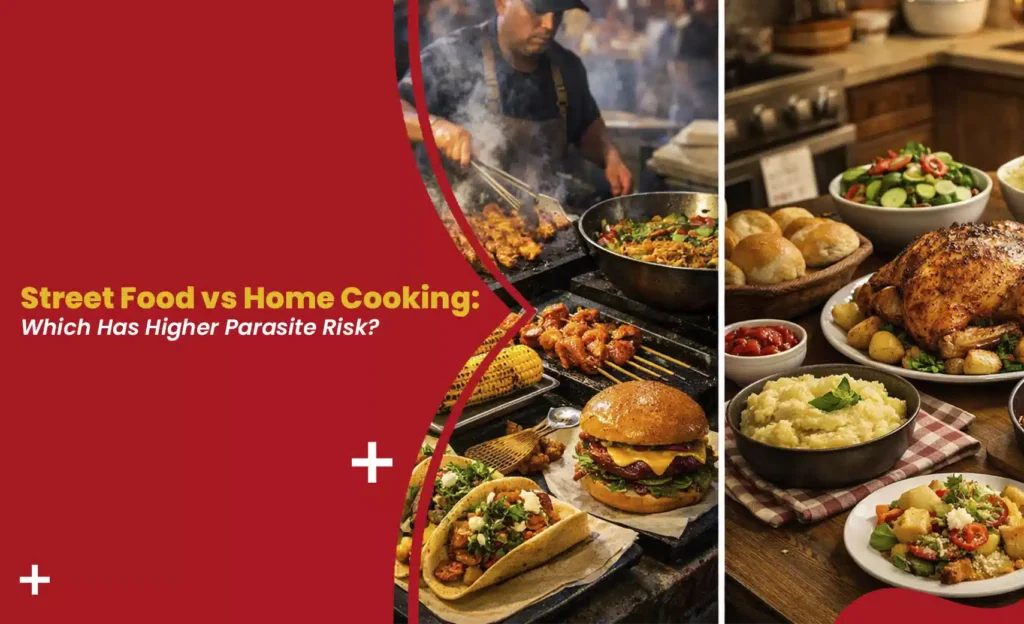
There’s a specific kind of joy that comes with street food.
You’re standing on a crowded pavement in Bangkok or Birmingham or Brooklyn. Something is sizzling. Someone is shouting orders. There’s spice in the air. You point, you pay, you eat. It feels alive.
And then, maybe a few hours later – or a few days – your stomach starts doing something you didn’t order.
Was it the street food?
Or is that just the easy scapegoat?
We tend to romanticize home cooking as safe and demonize street food as risky. But when it comes to parasite exposure, the truth is messier. It’s not a clean “outside bad, inside good” equation. Risk lives in details. In temperature. In hygiene habits. In water sources. In how long something sat before being served.
And sometimes, in pure chance.
Why parasites still matter in modern kitchens
Parasites feel like something from history books. Medieval villages. Travel documentaries. Developing nations.
But intestinal parasites haven’t disappeared. They’ve just become less visible in high-income countries.
In the US and UK, most cases are mild and underreported. Some come from travel. Some from improperly cooked meat. Some from contaminated produce – including produce washed in contaminated water. Occasionally, from household pets. Occasionally, from undercooked food made at home.
When infections are confirmed, doctors often prescribe medications like Albendazole 400 mg, depending on the organism involved. It’s commonly used for certain worm infections, including roundworms and hookworms.
But ideally, you never get to that point.
The street food stereotype
Street food carries a reputation: risky water, exposed ingredients, questionable handwashing.
And yes – in some regions with poor sanitation infrastructure, parasite transmission risk can be higher in street settings. If raw vegetables are rinsed in untreated water, or meat isn’t cooked thoroughly, parasites can survive long enough to infect the next person.
But here’s what’s interesting.
Street vendors who rely on repeat customers often maintain surprisingly strict hygiene routines. Their livelihood depends on it. I’ve interviewed vendors who change oil obsessively, boil utensils, and cook everything at high temperatures precisely because reputation matters.
Heat is powerful. Proper cooking kills most parasites effectively.
Which means risk isn’t automatically baked into the street environment.
Home kitchens aren’t automatically safe
We assume our own kitchens are controlled environments.
But think about it.
How often do you check the internal temperature of chicken?
How long does ground meat sit out while you scroll your phone?
Do you rinse cutting boards thoroughly after preparing raw meat?
Parasite eggs are microscopic. Cross-contamination doesn’t make dramatic announcements.
In some studies, home kitchens show contamination rates similar to commercial food environments – not because people are careless, but because habits get comfortable.
And comfort breeds shortcuts.
When home-cooked meals lead to confirmed parasitic infections, treatments like Albendazole 400 mg may be prescribed. But those infections often stem from simple oversights: undercooked pork, unwashed herbs, raw vegetables grown in contaminated soil.
Not street food.
Home food.
Water: the quiet variable
One of the biggest risk factors for parasites isn’t the cooking method – it’s water.
Street vendors in regions with untreated water supplies face higher contamination risks, especially when serving raw garnishes or beverages made with local ice.
At home, if you’re in the US or UK, municipal water is generally treated. That reduces risk significantly. But imported produce washed before distribution can still carry microscopic parasites if contamination occurred earlier in the supply chain.
You don’t see that part.
You just see the salad.
Meat matters – wherever it’s cooked
Undercooked meat is one of the most consistent parasite risks globally. Pork, beef, and fish can all harbor parasitic organisms if not cooked thoroughly.
Street stalls that grill meat to high internal temperatures can actually reduce risk compared to a home cook who prefers medium-rare pork.
Parasites don’t care about ambiance. They care about temperature.
If an infection does occur – say from tapeworm or roundworm – medications such as Albendazole 400 mg are often first-line therapy. It’s effective, widely used, and generally well tolerated when prescribed appropriately.
But again, treatment is the backup plan. Prevention is the goal.
Travel changes the equation
When traveling, parasite risk can increase – especially in regions where sanitation systems differ significantly from what you’re used to.
That doesn’t mean avoid all street food. It means observe. Is food cooked fresh in front of you? Is it piping hot? Is raw produce avoided? These details matter more than whether the vendor is mobile or stationary.
Ironically, large hotel buffets sometimes pose higher risk than fresh street grills, simply because food sits out longer.
I’ve gotten food poisoning at a resort once. I’ve eaten street food dozens of times without issue.
Experience doesn’t equal immunity. But it does shift perspective.
Children, immunity, and exposure
Children are more vulnerable to parasites, partly because of developing immune systems and partly because of hand-to-mouth habits.
Whether food is from a street cart or a home kitchen, hygiene matters.
And if a child is diagnosed with certain intestinal worms, pediatric dosing of Albendazole 400 mg may be recommended under medical supervision. It’s commonly used in children when clinically indicated.
But ideally, children learn early about handwashing, avoiding raw foods in high-risk settings, and understanding that not every delicious-looking snack is worth the gamble.
The psychology of blame
When someone gets sick after travel, they blame the street vendor.
When someone gets sick at home, they blame “a stomach bug.”
The narrative often follows assumption, not evidence.
Doctors confirm parasitic infections through stool tests. In certain cases, doctors may prescribe ivermectin depending on the type of parasitic infection. Once confirmed, Albendazole 400 mg is frequently prescribed depending on species and severity.
But by then, tracing the exact source can be nearly impossible.
Was it the shawarma in Istanbul? Or the undercooked lamb at a backyard barbecue three weeks earlier?
Parasites don’t leave receipts.
Hygiene is portable
The most consistent predictor of reduced parasite risk isn’t location – it’s hygiene.
Wash hands before eating.
Avoid raw produce in high-risk travel regions.
Cook meat thoroughly.
Use clean water sources.
Those habits apply equally to street food and home cooking.
Even the cleanest home kitchen can become a contamination zone if handwashing is skipped after handling raw meat.
And even the most chaotic-looking street stall can be relatively safe if food is cooked fresh at high heat.
What about raw foods and trendy diets?
Raw food diets, lightly cured fish, backyard gardening – these are often associated with wellness culture. But they have to think about parasites.
Parasites can live in raw fish unless it is frozen in a certain way. Home-grown food that has been fertilized wrong can be dangerous. These things happen at home, not in a busy market.
When confirmed, physicians may treat infections with Albendazole 400 mg, especially for roundworm or hookworm cases.
Prevention doesn’t mean paranoia. It means informed caution.
So which is riskier?
Street food or home cooking?
It depends.
In regions with poor sanitation and untreated water, street food may pose higher risk – particularly raw items.
In regions with strong public health infrastructure, risk often depends more on cooking practices than setting.
Home kitchens are not sterile laboratories. Street stalls are not automatically hazardous.
Parasite risk is shaped by temperature, water, hygiene, and handling – not geography alone.
A grounded conclusion
We love simple answers.
“Never eat street food.”
“Home cooking is always safer.”
Neither statement holds up completely.
Parasites don’t care where the food was prepared. They care whether they survive preparation.
If infection does happen, medications like Albendazole 400 mg are effective treatments when prescribed appropriately. In some cases, doctors may recommend other antiparasitic treatment options depending on the specific infection. But the goal isn’t to rely on medication after the fact.
It’s to build habits that quietly reduce risk.
Observe. Cook thoroughly. Wash hands. Be cautious with raw foods in unfamiliar environments.
Street food can be safe. Home cooking can be risky. Or vice versa.
The difference often lives in the details – not the location.
FAQs
1. I ate street food on vacation and now my stomach feels weird. Should I assume it’s parasites?
Not immediately. Most stomach issues after travel are short-lived and caused by bacteria or simple dietary change. Parasites usually cause symptoms that linger – ongoing abdominal discomfort, unexplained fatigue, persistent diarrhea, sometimes weight loss. If it clears in a day or two, it’s probably not parasites. If it hangs around? That’s when a doctor visit makes sense.
2. Is home-cooked food automatically safer than street food?
Honestly, no. It feels safer because it’s familiar. But undercooked meat, unwashed herbs, and cross-contaminated cutting boards happen at home all the time. Street vendors who cook food fresh at high heat can sometimes be safer than a distracted home cook multitasking between emails and dinner.
3. How would I even know if I have a parasitic infection?
The tricky part is that symptoms can be subtle. Ongoing stomach cramps, unexplained itching (especially at night), prolonged digestive upset, or fatigue that doesn’t make sense are common clues. It’s rarely dramatic at first. If symptoms persist beyond a week or two, testing – not guessing – is the smart move.
4. Should I avoid street food completely to stay safe?
Not necessarily. Street food is part of culture, travel, and community. Being aware is the key. Pick stalls where the food is made fresh and served hot. Don’t use raw garnishes in places where they could get you sick. Watch hygiene practices. You don’t have to live in fear – just stay observant.
5. If I do get parasites, does that mean I was careless?
No. Parasite exposure isn’t a moral failure. It happens to cautious, educated people all the time. The important thing is recognizing symptoms early and seeking proper medical care instead of ignoring it out of embarrassment. Infection doesn’t mean irresponsibility – it just means biology won one round.